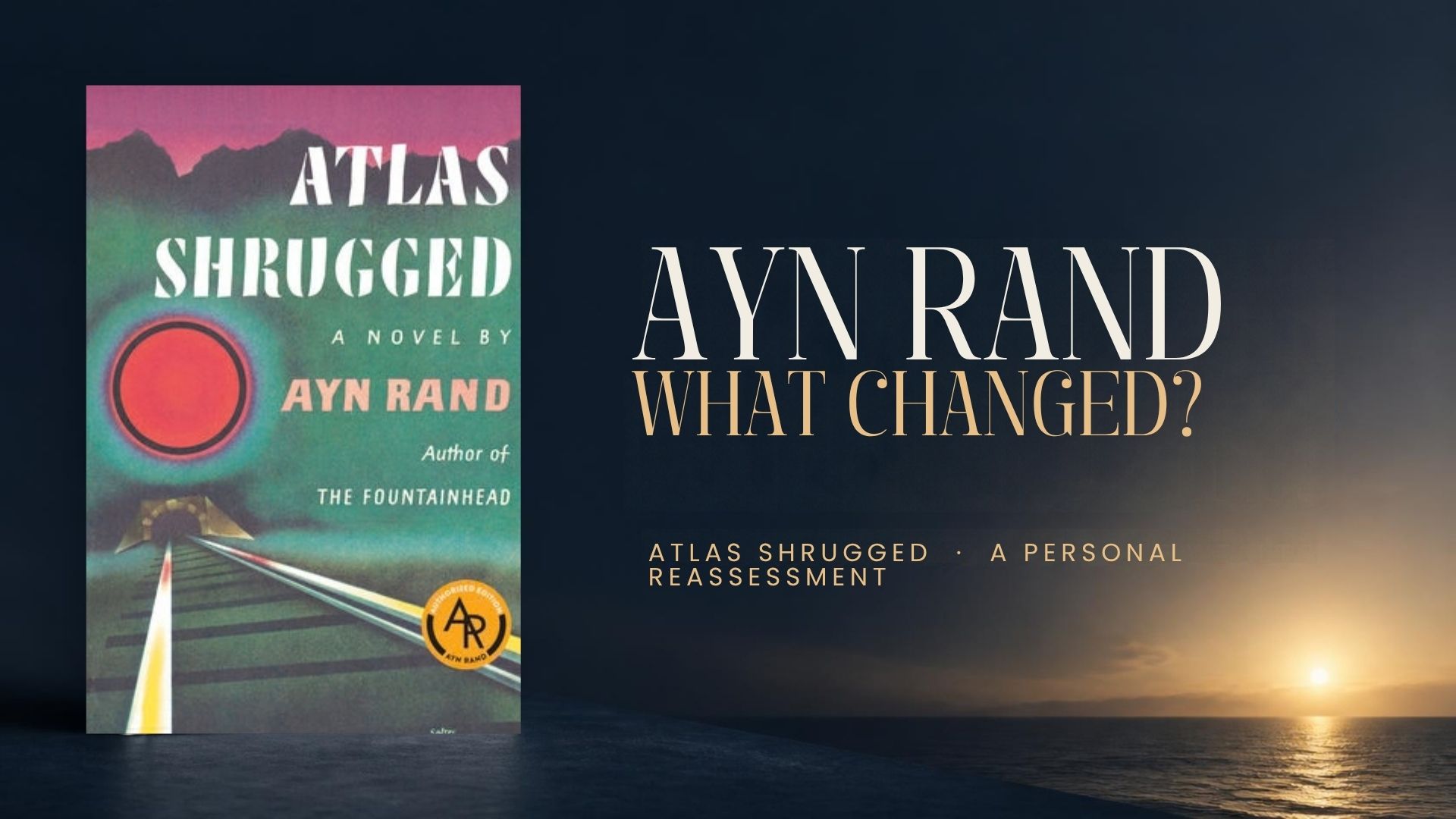

In 2017, I published an article titled Ayn Rand, i libri e il potere dei SOLDI — Ayn Rand, Books, and the Power of Money.
Reading it again almost ten years later was an interesting experience.
I was enthusiastic about Rand’s philosophy, and I wasn’t particularly interested in moderation. I argued that Italy needed more entrepreneurs, fewer people expecting somebody else to solve their problems, and a better appreciation of those who take risks and create wealth.
I even described entrepreneurs as the closest thing we have to modern heroes.
At the time, I meant it.
I’d recently built my own business after years of working in my family’s bar and struggling to find a professional direction. Copy Persuasivo® was growing, I was earning money independently, and for the first time I could see a future in which I wouldn’t have to work for somebody else.
Ayn Rand’s novels had helped me imagine that future.
I had read The Fountainhead, Atlas Shrugged, and several of her other books. Her celebration of individual achievement, independence and productive work resonated enormously with me.
In my 2018 diary, I even wrote that I could become the person who introduced her philosophy to Italian entrepreneurs.
I never pursued that project. In fact, a few months later I decided to keep most of my political and philosophical opinions to myself and concentrate on building my business.
Probably a sensible decision.
Still, Rand remained an important intellectual reference for years.
What changed wasn’t my appreciation of individual freedom or entrepreneurship. Those values are still central to my life.
I simply became less convinced that Rand’s philosophy offered a particularly good explanation of human behaviour, business or happiness.
Why Ayn Rand appealed to me so much
To understand my enthusiasm, you need to know a little about where I came from.
I grew up in Gaeta, a coastal town in central-southern Italy, in a family of small business owners.
For seventeen years I worked, in one capacity or another, in the family bar.
I knew what it meant to serve customers, deal with suppliers, work long hours and worry about revenue.
But for a substantial part of my youth, I was politically attracted to socialist and left-wing ideas. Local friends and school teachers influenced me.
I then studied political science and international relations. I travelled, lived abroad and considered working for international organizations.
I wanted to change the world, although I had only a vague idea of how I might make a living.
By my mid-twenties, my experiences were gradually changing my outlook.
I became more interested in individual initiative, markets and the possibility of creating an independent career.
I didn’t have wealthy parents financing an entrepreneurial adventure. Nor did I have a particularly valuable professional qualification that guaranteed a good salary.
What I had was curiosity, the ability to learn and a growing determination not to spend my life doing work I hadn’t chosen.
I began studying marketing, copywriting and entrepreneurship.
Then, in 2015, I started building Copy Persuasivo®.
Ayn Rand’s heroes suddenly made a lot of sense.
The Fountainhead, Atlas Shrugged and the attraction of independence
In The Fountainhead, published in 1943, architect Howard Roark refuses to compromise his creative vision merely to satisfy convention or public opinion.
In Atlas Shrugged, published in 1957, Rand presents a world where productive individuals, inventors and industrialists are increasingly constrained by political power and demands made in the name of society.
The novels contain plenty of melodrama, lengthy speeches and characters designed to embody philosophical principles.
But they also convey something that appealed strongly to my younger self: admiration for people who create and build – rather than merely conform.
Rand’s philosophy, which she called Objectivism, places reason, individual rights, rational self-interest and laissez-faire capitalism at the centre of its worldview.
I found this liberating.
I’d spent years thinking about what society expected from me, what career I should choose and what qualifications I needed.
Rand offered a very different perspective.
Instead of waiting for permission, I could develop valuable skills and find people willing to pay for them.
And that’s more or less what I did.
When I started offering direct-response copywriting services in Italy, the market wasn’t particularly well developed.
Some people told me that selling copywriting services wasn’t a viable model. They were more interested in selling courses teaching entrepreneurs to write their own marketing materials.
I disagreed.
Businesses needed customers, and good marketing could help them acquire those customers. I didn’t see why I couldn’t make a living providing that service.
So I started.
By the time I wrote my enthusiastic article about Rand in 2017, the business was already generating income and creating opportunities for collaborators.
From my perspective, her philosophy had been vindicated by experience.
What ten years of entrepreneurship taught me
I still believe entrepreneurship can be a wonderful way to improve your life.
My own experience is proof enough for me.
Over the following years, I built a profitable marketing business, worked with companies in dozens of industries, created books and training products, and eventually began investing in residential real estate.
By early 2025, the recurring income from my activities and investments was sufficient to cover my family’s living expenses.
I’d achieved the financial independence I’d been pursuing for a decade.
I was also considerably more experienced than the man who wrote that 2017 article.
I’d seen successful entrepreneurs make foolish decisions. I’d watched businesses generate substantial revenue while delivering questionable value. I’d encountered clients who wanted marketing to compensate for poor products, weak management or unrealistic expectations.
And I’d made plenty of mistakes myself.
Gradually, I became less comfortable with the idea that entrepreneurs are inherently heroic simply because they produce and sell things.
Some certainly deserve admiration.
Others are mediocre, irresponsible or dishonest.
Most are ordinary people with a mixture of good and bad qualities.
Their contribution should be evaluated through what they actually create and the consequences of their decisions, not merely through their professional identity.
That may sound obvious.
But it’s less obvious when you’re emotionally invested in a philosophy that presents productive entrepreneurs as moral exemplars.
The problem with marketing
This is where my professional experience created an uncomfortable contradiction.
I’m a marketer.
I’ve studied persuasion and direct-response advertising for years, including the work of Dan Kennedy, one of the most influential teachers in my professional development (and a great fan of Rand too).
I understand how emotions influence purchasing decisions.
I also understand that people frequently buy things they don’t need, based on exaggerated expectations or superficial appeals.
Marketing can help customers discover excellent products. It can make useful services more accessible and allow small businesses to compete with larger organizations.
But it can also be used to sell unnecessary, harmful or overpriced products.
I’ve spent enough time in the industry to recognize both sides.
In a diary entry from late 2025, I reflected on how strange it was to reconcile Rand’s idealized account of rational capitalism with a commercial world that frequently encourages IRRATIONAL consumption.
Financial products, insurance packages, software, courses, consumer goods — all can be genuinely useful, but none becomes useful simply because somebody manages to sell it.
The fact that an exchange is voluntary doesn’t automatically tell us whether the customer made a well-informed decision.
And the fact that a company is profitable doesn’t settle the question of whether it creates more value than it destroys.
I didn’t reach these conclusions because I stopped believing in markets.
I’m still a capitalist, both philosophically and in the practical sense that I own and invest capital.
But I no longer think market outcomes should be treated as moral verdicts.
Then Albert Ellis entered the picture
In August 2026, while spending time with my family around Gaeta and Formia, I returned to studying the psychologist Albert Ellis.
I had been listening to A Guide to Rational Living, and his approach to psychology interested me enough to explore his other work.
I came across a book with a rather provocative title: Is Objectivism a Religion?
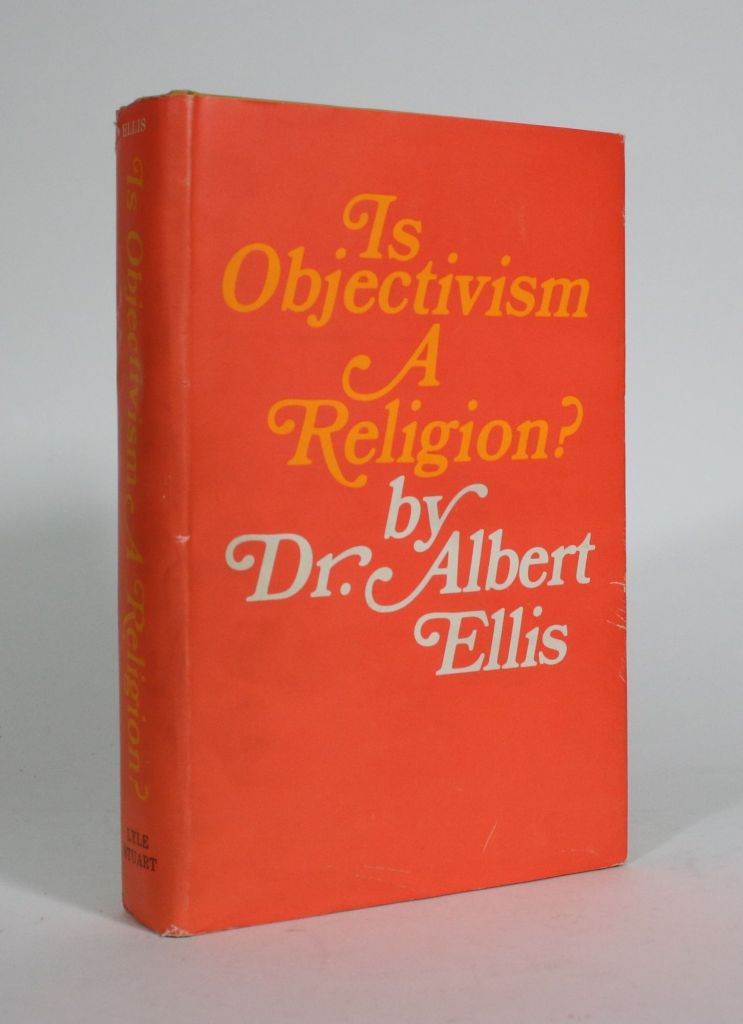
Published in 1968, it examines and challenges Ayn Rand’s philosophy.
That immediately caught my attention.
I’d read criticism of Rand before, but much of it seemed driven by political disagreement rather than a serious attempt to examine her reasoning.
Ellis was different.
He was a psychologist whose work had helped establish rational-emotive therapy, the precursor to what became Rational Emotive Behavior Therapy, or REBT.
He took rational thought seriously.
Yet he also questioned whether supposedly rational philosophical systems could become rigid, unrealistic and psychologically harmful.
I explored his critique and found it unusually convincing.
I had spent years admiring Rand’s insistence on reason. But I was increasingly aware of how easily a commitment to rationality could become an excuse for judging other people against an abstract ideal.
A person doesn’t become more rational simply by believing that rationality is the supreme human virtue.
Nor does calling somebody irrational necessarily help us understand their behaviour.
Ellis helped me distinguish between being rational and being rationalistic.
I still find that distinction useful.
Reason is an instrument for understanding reality.
It becomes less useful when we turn our preferred conclusions into dogmas and then dismiss whatever doesn’t fit.
I don’t want to replace Objectivism with another intellectual system that claims to have all the answers.
I want to be better at recognizing when I’m wrong.
My relationships changed how I think about selfishness
One of Rand’s most controversial ideas concerns selfishness.
She defended rational self-interest and rejected the idea that morality requires individuals to sacrifice their lives and values for others.
I understood the appeal.
When I was young, I wanted to become independent, stop relying on other people and pursue my own ambitions.
That remains important to me.
But I’m now married and have two children.
And I’ve discovered that a considerable part of what makes my life satisfying involves doing things for other people, sometimes without expecting anything in return.
There are days when I’d rather work, study or write than deal with another family obligation.
Occasionally, I don’t particularly feel like being generous or patient.
Yet choosing to help Paola, spend time with the children or support somebody I care about often makes my life better.
I don’t need to calculate the personal return on every act of affection.
I also don’t need to interpret ordinary generosity as a betrayal of my own interests.
Of course, Rand’s philosophy distinguishes voluntary generosity from compulsory self-sacrifice. It would be unfair to suggest she opposed every form of kindness.
Still, I’ve become less interested in treating relationships through the language of individual benefit and obligation.
A few years ago, I was much more transactional in my thinking.
I evaluated activities according to what they contributed to my development, career or financial position.
I still do this quite often. Old habits die hard.
But family life, meditation and several years of financial security have made me appreciate forms of satisfaction that aren’t easily measured.
Why I don’t share Rand’s politics anymore
Another disagreement concerns the role of government.
Rand’s political ideal was a form of laissez-faire capitalism in which the government’s legitimate functions were severely limited, primarily to protecting individual rights.
I understand the appeal of limiting state power.
I grew up in Italy, where bureaucracy, taxation and inefficient public administration can create enormous frustration for business owners.
I’ve experienced plenty of that myself.
But I also live in a country with public healthcare and education, and I consider both essential institutions.
I don’t think markets perform equally well in every sector.
Healthcare presents problems of information, incentives, access and vulnerability that are difficult to resolve through ordinary consumer choice.
Education has substantial social consequences beyond the immediate interests of an individual student.
I therefore support an important public role in both, even while recognizing the inefficiencies and failures that public systems can produce.
This doesn’t make me hostile to entrepreneurship or private competition.
Nor does it mean that every government intervention is justified.
I’m simply more pragmatic than I used to be.
I remain broadly sympathetic to classical liberalism, individual responsibility and economic freedom, but I’m no longer interested in defending an ideology at all costs.
I prefer examining policies and institutions according to their actual consequences.
Rand helped me appreciate individual initiative.
Experience helped me recognize that individual initiative operates within a much more complicated society than her novels tend to acknowledge.
What I still admire about Ayn Rand
I haven’t rejected everything. Far from it.
I still admire Rand’s insistence that people can shape their own lives through thought, effort and productive work.
I also appreciate her refusal to glorify mediocrity or treat ambition as something shameful.
Those ideas mattered to me when I was trying to escape a professional situation I didn’t enjoy.
They still matter when I see people resign themselves to circumstances they could plausibly improve.
Rand also had considerable literary ambition.
She built a distinctive intellectual identity through novels, essays, public lectures and years of writing. Whatever one thinks of her conclusions, the scale of her achievement as an author and communicator is remarkable.
That interested me enormously when I wrote about her in 2017.
It still does.
I’m an author myself, though on a vastly smaller scale, and I know how difficult it is to create work that people continue discussing decades after publication.
I’d also defend her emphasis on excellence.
I don’t believe we should celebrate every outcome as equally admirable or pretend that skill, discipline and effort don’t matter.
I want to become better at what I do.
I want my businesses to perform well, my investments to be sound and my books to be worth reading.
What has changed is my willingness to turn that preference into a judgment about the worth of other people.
Reading my younger self
Returning to my old article was more revealing than I expected.
In 2017, I was still building the financial and professional independence that I have today.
I was grateful to Rand because her philosophy seemed to explain why my efforts were paying off.
I had been willing to challenge conventions and take risks, and the market was rewarding me.
In 2026, I have more resources, experience and freedom. I also have more responsibilities and a better understanding of my own limitations.
Some of the confidence expressed in that old article now seems excessive.
But I don’t feel embarrassed about having written it.
It reflects an important stage in my development.
I’d rather leave the article online than quietly rewrite my intellectual history.
I’m not interested in pretending that my current opinions are final.
Perhaps I’ll reconsider some of them again.
That’s one of the reasons I keep reading, writing and maintaining a private diary.
Should you read Ayn Rand today?
I think The Fountainhead and Atlas Shrugged are worth reading, particularly if you’re interested in individualism, capitalism and the relationship between philosophy and fiction.
They are long, occasionally repetitive novels with highly idealized characters. Rand doesn’t make much effort to hide what she wants readers to believe.
That may irritate you. It occasionally irritated me too.
But they’re influential works, and I found them stimulating enough to continue reading much of her nonfiction.
I wouldn’t recommend treating them as manuals for life or business.
I’d suggest reading Rand alongside critics such as Albert Ellis, as well as economists, psychologists and philosophers who approach human behaviour from different directions.
Then compare what you read with your own experience.
That’s what I’ve been doing, more or less, for the past decade.
I still believe that individual freedom, responsibility and productive ambition can transform a person’s life. They certainly transformed mine.
I also believe that successful entrepreneurs can be wrong, profitable businesses can produce harmful outcomes, and genuine relationships sometimes require us to stop calculating everything.
My younger self might have considered those concessions.
Today they seem like fairly ordinary observations about living among other human beings.
Andrew Lisi is an Italian entrepreneur, writer and real estate investor. He founded Copy Persuasivo® in 2015 and writes about business, philosophy, books and personal development on Eyes to See.

