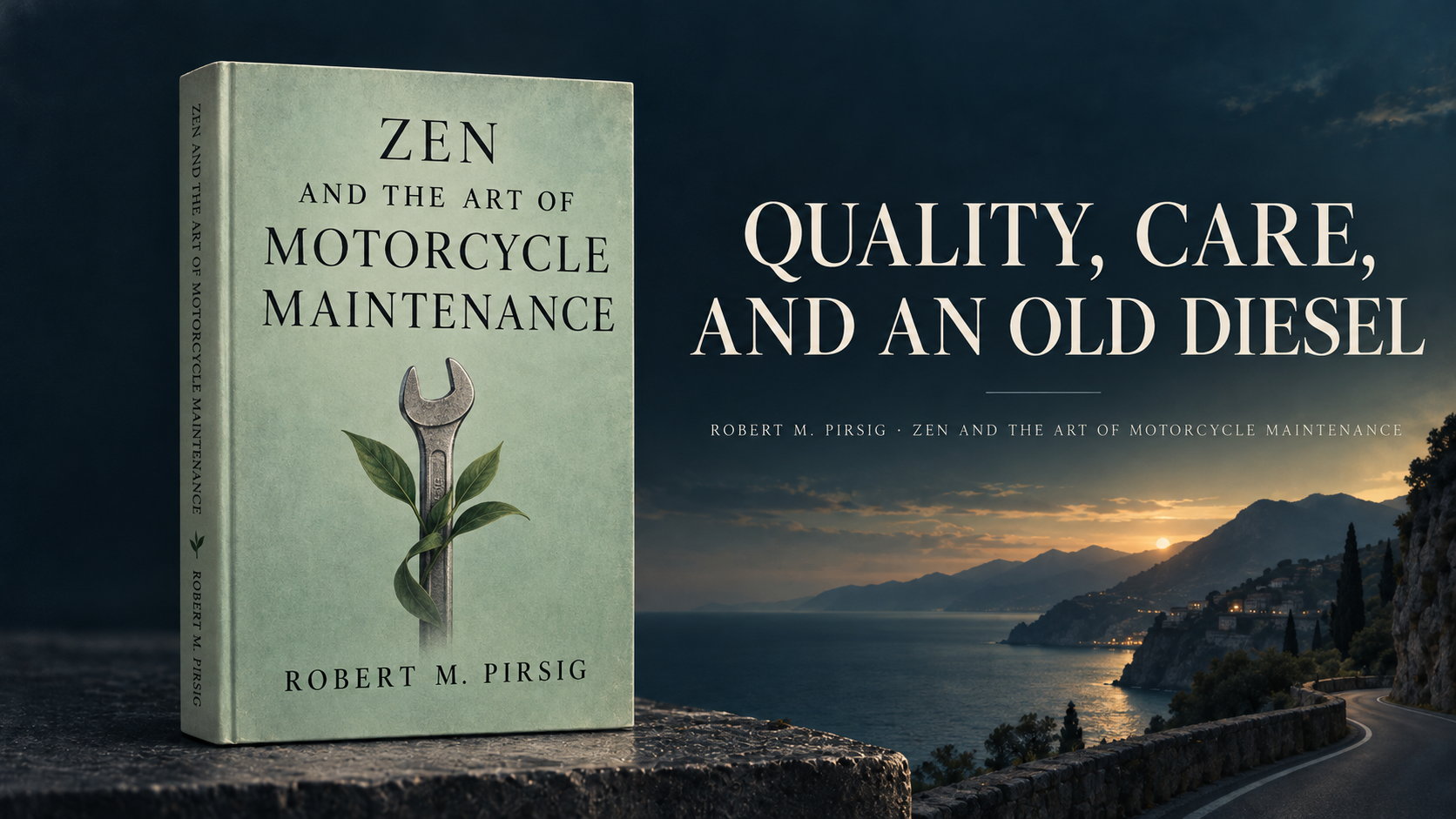

In July 2025, I was travelling around Italy with my wife and two children, reading Robert Pirsig’s Zen and the Art of Motorcycle Maintenance and trying to understand what was wrong with our car.
The car was eight years old, a diesel with more than 92,000 kilometres on the clock. We’d used it for countless family trips, including several holidays in the mountains of South Tyrol.
I liked it. Still do. It’s spacious enough for the four of us, reasonably economical and generally reliable.
But I’d never been particularly interested in how it worked.
I paid mechanics to take care of that.
Until I discovered that some important maintenance had been neglected, particularly the brakes, and that my indifference could have exposed my family to unnecessary risks.
I felt guilty and rather stupid. I also became increasingly annoyed with the mechanics who didn’t seem particularly concerned about what I considered serious problems.
Then, while trying to become more familiar with the car, I managed to pour AdBlue into the windshield-washer reservoir, mistaking it for demineralized water.
Una bella cazzata.
At least I was learning.
The timing made me appreciate Pirsig’s book considerably more than I otherwise might have.
Pirsig’s book wasn’t entirely new to me. Back in 2008 or 2009, my old friend Mohamed—the frontman of a band I played with in Rome—was the first person to introduce me to it. So here’s a small shout-out to him, and to that chapter of our lives.
Here’s Gemente performing La strada live in Calcata on 9 May 2009.
What is Zen and the Art of Motorcycle Maintenance about?
Published in 1974, Zen and the Art of Motorcycle Maintenance: An Inquiry into Values is based on a motorcycle journey Pirsig took with his son Chris across the United States in 1968.
It’s a mixture of autobiographical fiction, travel writing and philosophy. The author explores technology, reasoning, craftsmanship and, above all, the nature of Quality.
What makes something good?
How do we recognize good work? Why do certain activities become satisfying when we approach them with care, while the same activities can feel tedious or frustrating when we don’t?
Pirsig spends a considerable number of pages pursuing these questions.
Sometimes I found his reflections fascinating. At other times, frankly, I wished he’d get to the point.
The book isn’t an introduction to motorcycle repair, despite the title. Nor is it a systematic explanation of Zen Buddhism.
Its philosophical ambitions go considerably further, and that sometimes makes it a demanding read.
But I enjoyed discovering Pirsig himself almost as much as his ideas.
Before becoming a successful author, he’d worked as a technical writer and teacher. He was exceptionally intelligent, deeply interested in philosophy and uncomfortable with certain institutional conventions.
That combination appealed to me.
I’ve spent much of my professional life writing practical material for businesses, while also studying history, philosophy and literature. I eventually started writing adventure novels too.
Pirsig’s ability to bring such different interests together in a single work intrigued me, even when I found the result rather cumbersome.
My car, the mechanics and the problem of not knowing enough
During our summer travels, I’d started noticing problems with the car that deserved more attention than I’d given them.
The condition of the brakes was the most worrying.
I’d been relying on mechanics to tell me what needed doing, without understanding enough to evaluate their advice or recognize when something had been overlooked.
That had worked reasonably well for years.
Until it didn’t.
After dealing with several professionals and getting less reassurance than I’d hoped for, I started researching the problems myself. I learned more about the components involved, asked questions and arranged the most urgent repairs.
The immediate work cost less than €400.
A manageable expense, especially compared with the possible consequences of ignoring the problem.
But it bothered me that I’d spent years learning how to evaluate complex financial investments while knowing so little about an object I used to transport my wife and children.
I could discuss mortgage terms, rental yields and cash flow with considerable confidence.
Yet opening the hood of my own car made me feel like a complete beginner.
Pirsig gave me a useful way to think about that contradiction.
There is a difference between deciding that somebody else should perform a technical task and deciding that the entire subject is none of your concern.
I still believe in hiring competent professionals. I’m not interested in replacing my mechanic.
But if I have no understanding of what he’s doing, I’m entirely dependent on his judgment and integrity.
And neither can be taken for granted.
The AdBlue incident
I should probably explain how far my mechanical education had progressed.
After dealing with the urgent repairs, I was becoming more willing to open the hood, check things and understand the basic systems.
Then I found myself holding what I thought was a container of demineralized water and poured its contents into the windshield-washer reservoir.
It was AdBlue.
I had managed to make a mistake while trying to become more knowledgeable.
A rather predictable outcome, in retrospect.
I was annoyed with myself, although the incident also made me realize how unfamiliar I still was with the car.
I haven’t suddenly become mechanically inclined. I don’t enjoy spending hours researching engine components, and I can think of many things I’d rather do on a Saturday morning.
But I now approach the vehicle with more attention and respect.
It’s carried us safely for years. I’d like to keep it for several more, if that remains sensible.
And I’d prefer not to discover the next serious maintenance problem while driving through the Alps with my children in the back.
The strange pleasure of driving
Another thing happened that summer.
I started enjoying the act of driving more than usual.
On our return journey from South Tyrol to Ravenna, I found myself paying closer attention to the road, the car and the journey itself.
In my diary I described it almost as a game.
I was getting an enjoyable experience for free, while doing something necessary.
Of course, driving isn’t literally free. There’s fuel, depreciation, maintenance and plenty of other expenses. I meant that I didn’t need to purchase some additional entertainment to enjoy what I was already doing.
I was travelling through beautiful landscapes, concentrating on the road and taking my family home.
That was enough.
It’s easy for me to forget this.
I’m constantly studying, exploring ideas and looking for ways to improve my businesses or acquire new skills. I can turn almost any activity into another project.
Sometimes this curiosity is enormously productive.
Sometimes it prevents me from appreciating the experience I’m already having.
I’ve noticed something similar while spending time with my children. I may be physically present and enjoying myself, but part of my mind is still thinking about work or some unfinished manuscript.
Pirsig’s discussion of Quality helped me appreciate how attention changes the experience of an ordinary activity.
I didn’t need to become a motorcycle enthusiast to recognize that.
My old diesel was quite sufficient.
What this has to do with my work
I’ve been in business for more than ten years.
I started as a copywriter, built a marketing operation serving small and medium-sized Italian companies, and eventually began investing in residential properties.
Both businesses depend heavily on the work of other people.
I hire designers, developers, marketers, electricians, plumbers, architects and various other professionals.
Some are excellent.
Others are mediocre.
A few have caused me enough trouble to wonder whether delegating the work was worth it.
I’ve learned that there is a tremendous difference between a professional who completes an assigned task and somebody who genuinely cares about the quality of the result.
A website can be delivered on time, meet the technical specifications and still be disappointing.
A marketing campaign can generate leads while producing very little business for the client.
A contractor can complete a renovation while leaving behind defects that become visible months later.
The customer may not have the technical knowledge to recognize those problems immediately.
That makes professional judgment and responsibility particularly valuable.
Years ago, my team worked on a marketing project for an independent automotive repair business in the Italian mountains.
We documented how positioning, useful information and the owner’s professional reputation helped the business attract and retain customers. You can read the case study on Copy Persuasivo®.
Revisiting that experience after dealing with my own mechanics was rather interesting.
As a marketer, I knew how important trust and perceived competence were when selling technical services.
As a customer, I had just been reminded why those things matter in the first place.
There’s a difference between convincing people that you’re trustworthy and actually deserving their trust.
A good business needs both.
Quality also matters when nobody is paying you
Financial independence has made my relationship with work more complicated.
In February 2025, I realized that my recurring income was sufficient to cover my family’s expenses without requiring me to work every day.
I’d spent a decade pursuing that freedom. Then I reached it and started wondering what I should do next.
I enjoy entrepreneurship, but not every aspect of it.
I like strategy, creating useful products, negotiating and finding better ways to organize businesses. I don’t particularly enjoy bureaucracy, managing unreliable collaborators or dealing with anxious clients who expect immediate results without doing their part.
With less financial pressure, I began to reconsider which activities deserved my attention.
Writing became increasingly important.
I’d already published my first adventure novel, Machsom, and was working on its sequel, Meskèl. I was also preparing a family memoir based on interviews with my parents.
These projects were not especially profitable.
In fact, compared with my marketing work, writing fiction seemed like a pretty poor use of my time from a strictly financial point of view.
But I wanted to do it.
And I wanted to do it well.
This is where Pirsig became useful again.
The satisfaction of doing something carefully doesn’t necessarily depend on what somebody else is willing to pay for it.
I know what it feels like to improve a passage of prose until it finally reads the way I intended. I also know what it feels like to spend hours revising something that still doesn’t work.
There’s frustration, certainly.
But there’s also pleasure in the work itself.
I’ve written about similar ideas in my essay on Dan Koe’s Purpose & Profit.
Pirsig approached the subject from a different direction, but I found the connection interesting.
Having the freedom to choose my work doesn’t remove the difficulty of doing it properly.
Nor should it.
Where I struggled with Pirsig
Despite finding the book influential, I wouldn’t describe it as an easy or consistently enjoyable read.
Some philosophical passages are extraordinarily long.
The narrative sometimes seems to disappear beneath the author’s intellectual investigation.
And I often wondered whether certain arguments could have been presented more clearly.
I’m suspicious of the idea that a difficult subject necessarily requires difficult prose.
That may be unfair to Pirsig, whose ambitions were substantial and whose book was written for a very different literary environment.
But it’s a preference I’ve developed through years of professional writing.
If I understand something, I want to make it accessible.
That doesn’t mean reducing every idea to a slogan. It means respecting the reader’s time and attention.
Later that summer, a friend recommended Eugen Herrigel’s Zen in the Art of Archery.
I initially found it more direct and easier to follow as an introduction to certain ideas associated with Zen. I subsequently returned to it more critically, so I wouldn’t present it as an unquestionable authority.
Still, the comparison helped me clarify what I want from philosophical writing.
Depth, certainly.
But also clarity.
I want to think about an idea, not spend half my attention trying to reconstruct the author’s sentence.
What I kept from the book
Looking back at my diary, the most important result wasn’t a new philosophical conviction.
It was a change in how I approached ordinary things.
I became more interested in the workings and maintenance of our car. I took more responsibility for understanding what professionals were doing on my behalf.
I also enjoyed driving more, partly because I was paying closer attention instead of treating the journey as wasted time between destinations.
And I found another way to think about the work I still wanted to do now that earning money was no longer my main concern.
Pirsig didn’t make me want to become a mechanic.
He did make me a little less comfortable with ignorance.
That’s a useful result for any book, especially one I’d initially approached out of curiosity rather than with a practical problem in mind.
There’s a final irony I enjoy.
While reading a book devoted partly to careful technical understanding, I managed to pour the wrong liquid into my car.
I’m sure Pirsig would have found something philosophical to say about that.
I just hope I won’t repeat the experiment.
Andrew Lisi is an Italian entrepreneur, writer and real estate investor. He founded Copy Persuasivo in 2015 and writes about business, books, philosophy, travel and personal development on Eyes to See.
Related reading
- The Smithsonian’s collection of Robert Pirsig’s motorcycle and manuscripts
- Writing Across Borders — Robert Pirsig and his work
- Dan Koe’s Purpose & Profit — After 10 Years of Living It
- How we helped position an independent automotive repair business
- My financial independence crisis — Il Baffo podcast

