
It was January 2026. I couldn’t sleep.
Too much coffee, probably.
So I picked up The 5 Types of Wealth by Sahil Bloom, a book I’d discovered through Goodreads and decided to read instead of settling for the usual summaries.
A few hours earlier, my wife and I had been watching The Beast in Me on Netflix. One of the episodes mentioned the idea of having enough.
And there it was again, in Bloom’s book.
Enough.
A deceptively simple word. One I’d been struggling with for almost a year.
Because here’s the thing.
In 2015, I started my copywriting business with less than €1,000 in savings. By early 2025, I’d reached financial independence. My business was profitable, my rental properties were generating recurring income, and I no longer needed to work every day to support my family.
By October 2026, my net worth was approaching €550,000.
Yet for some reason, I still had this financial goal in my head: make €20,000 a month while working no more than 20 hours a week.
Why?
What exactly was I going to do with that money?
That’s the question Sahil Bloom’s book helped me reconsider.
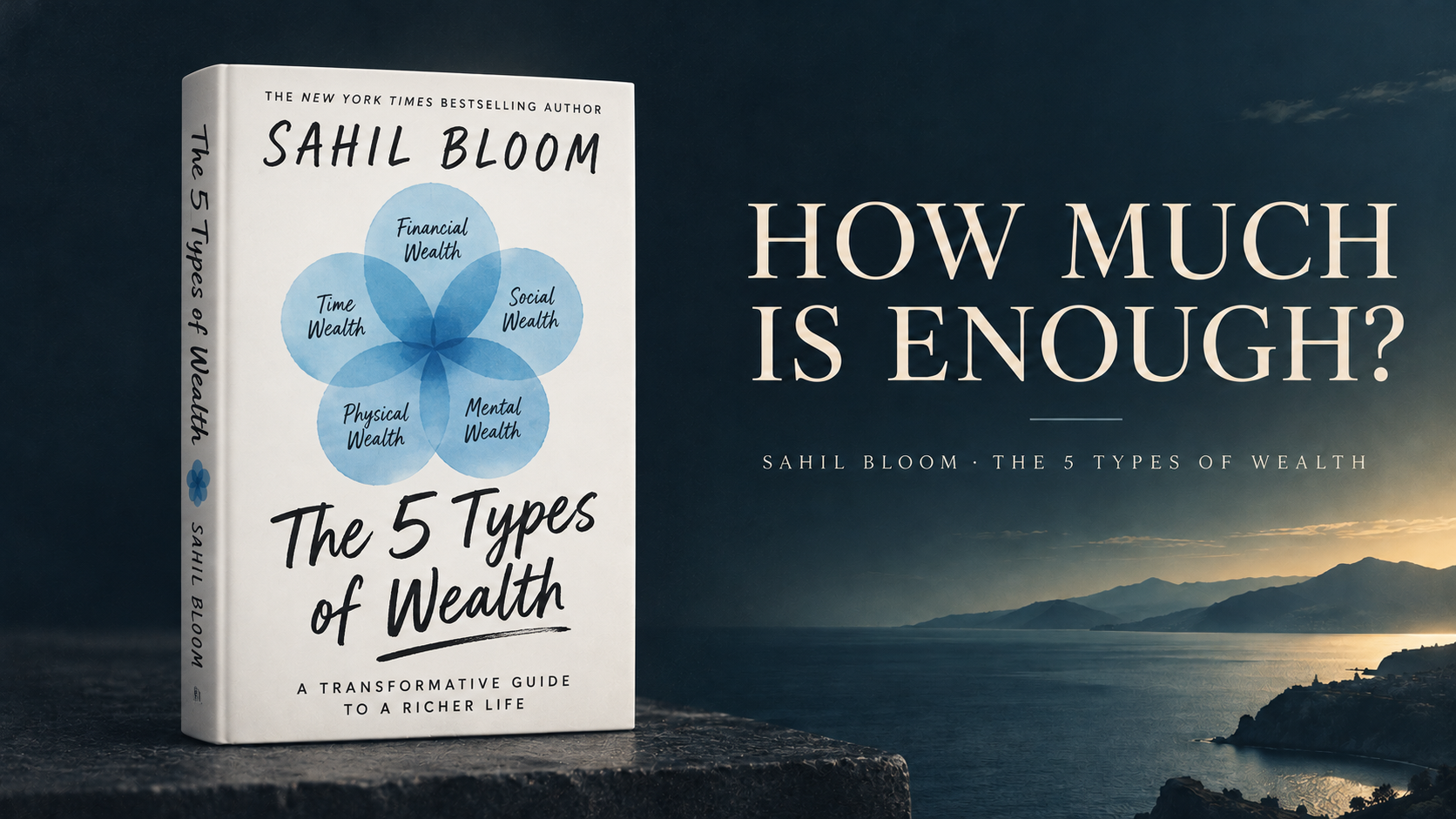
What are the five types of wealth?
The 5 Types of Wealth, published in 2025, argues that we’ve become too accustomed to measuring success through money.
Bloom proposes 5 interconnected dimensions of wealth:
- Time wealth: Control over your schedule and the freedom to spend time on what matters
- Social wealth: Relationships with family, friends, and the people you care about
- Mental wealth: Purpose, curiosity, clarity, and personal growth
- Physical wealth: Health, strength, energy, and longevity
- Financial wealth: Resources and financial security that support your life
None of this is revolutionary.
Philosophers have discussed similar ideas for centuries. Contemporary psychologists and researchers have written extensively about relationships, autonomy, health, and happiness.
I’ve encountered these concepts in dozens of books.
And yet I found Bloom’s framework useful.
Why?
Because recognizing a good idea isn’t the same as organizing your life around it.
I knew time was more valuable than money.
I’d been saying that for years.
But I was still behaving as though another financial milestone would somehow make my life better.
First €8,000 a month. Then €20,000. And then what?
My original financial target was around €8,000 a month.
At the time, that seemed like a lot of money. Enough to enjoy a comfortable life, support my family, travel, and invest.
Then I started thinking bigger.
Eventually, I settled on a more ambitious goal: €20,000 a month, working a maximum of 20 hours a week.
I’d been influenced by entrepreneurs and business thinkers who encourage people to constantly raise their targets.
Double your business.
Then double it again.
Or why not aim for ten times the results?
I understand the logic.
Ambitious goals can force you to rethink your assumptions, redesign your systems, and discover opportunities you would otherwise ignore.
I have benefited enormously from this approach.
Without studying marketing and entrepreneurship, I probably wouldn’t have built Copy Persuasivo® into a profitable business.
Without following more experienced real estate investors, I might never have found the courage to purchase my first rental properties.
But there’s a catch.
At some point, somebody else’s definition of ambition can become a very expensive distraction.
That’s what happened to me.
My €20,000 target was no longer connected to a specific problem I needed to solve.
It had become a number worth pursuing simply because it was bigger than the previous one.
And madonna santa, I know how seductive that game can be.
A quick reality check: I live in Italy, not California
There’s something worth explaining before going further.
I’m Italian.
I spend most of the year in Ravenna, a city in northeastern Italy. I also spend at least one month in Gaeta, the coastal town in central-southern Italy where I grew up.
My wife and I have two children.
We like travelling. I try to organize at least one substantial family holiday every year, along with several shorter trips.
We enjoy good food, comfortable accommodation, cultural experiences, and having enough time to enjoy them.
But we’re not trying to finance a luxury lifestyle in Manhattan or San Francisco.
And this matters when discussing money.
According to ISTAT, Italy’s national statistics institute, the median net annual household income for Italian couples with children was €49,894 in 2024.
That’s approximately €4,160 a month for the entire household.
Meanwhile, average monthly household consumption in Emilia-Romagna, the region where I live, was €3,159 in 2025.
These are different measures, of course. One describes household income, the other household spending. Neither represents my family’s exact budget.
Still, they provide some perspective.
€20,000 a month would mean €240,000 a year before considering exactly how that income is earned, taxed, or distributed.
That’s a substantial sum in Italy.
I don’t need anything close to that simply to maintain a comfortable family lifestyle.
I could certainly find ways to spend or invest it.
Another property. A larger home. More expensive holidays. New business ventures.
But here’s the question Bloom made me ask:
Would any of those things actually improve my life enough to justify the effort?
Sometimes the answer might be yes.
Often, I suspect, it wouldn’t.
I’m a time billionaire. But not for much longer
One of the most memorable ideas in Bloom’s book is the concept of being a time billionaire.
A billion seconds equals approximately 31.7 years.
When you’re young, you may have several billion seconds ahead of you.
At 39, assuming I live into my eighties, I could still have more than a billion seconds left.
Sounds wonderful.
But suddenly the number doesn’t look so enormous.
Every year consumes another 31.5 million seconds. And unlike money, I can’t earn them back.
I’ve spent years tracking income, profits, expenses, working hours, and investment returns.
I know how to calculate cash flow.
I know how to use financial leverage.
I know how to evaluate business opportunities.
But somehow I still occasionally treat time as though it were an unlimited resource.
I say yes to another project. I start studying another business model. I consider another investment.
I get excited about some new technology that might make me more productive.
And then I realize that the day is over.
What exactly did I gain?
Another interesting idea? Another possible source of income? Or just another commitment?
That’s when I start thinking: Non voglio più sbattermi per i soldi.
Roughly: I don’t want to keep busting my ass for money.
Not because money is bad. But because I’ve already spent a decade building the financial security I once dreamed about.
Why would I sacrifice that freedom just to make the numbers bigger?
My children made this impossible to ignore
Another section of the book really got to me.
Bloom discusses the limited window of childhood, when parents occupy an enormous part of their children’s world.
There’s no precise age at which this changes, of course.
But every parent knows what he’s talking about.
Young children want to spend time with YOU.
They want to play, talk, ask questions, show you things, and involve you in their discoveries.
Then, gradually, their world expands. Friends become more important. Independence grows.
And the opportunities you had when they were younger don’t come back.
I have a son and a daughter.
I’m fortunate enough to spend a great deal of time with them.
One morning, shortly after starting the book, I wrote in my diary about my typical Tuesday.
Our family helper was taking my son to school. I took my daughter.
Then I had time for my daily exercises, some quiet reflection, and planning my work.
No rush.
No boss expecting me at an office.
No desperate need to squeeze another billable hour into the morning.
That is wealth.
I know it because I remember what my life was like before.
But there’s also something uncomfortable.
Being physically present doesn’t necessarily mean being mentally available.
I can be playing with my children while thinking about an unfinished manuscript, a property renovation, or an annoying client.
The problem isn’t always the amount of time I spend working.
It’s the amount of attention work continues to consume after I’ve stopped.
And attention is another resource I can’t accumulate in a bank account.
The Toy Story lesson: focus on what matters
Bloom uses an analogy involving the rocket sequence near the end of Toy Story.
That made me smile.
My son has watched the movie, so I know that scene rather well. But the underlying lesson is serious.
Concentrated effort can produce extraordinary results.
Not necessarily linear results, where twice the work produces twice the output.
Sometimes sustained focus produces a breakthrough that changes everything.
I can recognize that pattern in my own life.
When I focused on copywriting and direct marketing, I developed skills that eventually became the foundation of my business.
When I began investing seriously in residential property, I spent months studying the market, evaluating buildings, negotiating, and learning how to organize renovations and rental operations.
Those periods of focus changed my financial situation.
The same thing happened in my personal life.
Choosing to build a relationship with Paola meant giving up other possibilities.
And thank goodness I did.
Our marriage has given me stability, affection, companionship, and two children.
It’s also given me the confidence and emotional support to pursue ambitious professional goals.
I sometimes wonder what my life would look like if I’d kept all my options open instead of committing deeply to a few important ones.
Probably a lot poorer. Not necessarily financially, but in almost everything else.
Focus isn’t just about getting more done. It’s about deciding what deserves your life.
The unfinished projects occupying my head
There’s a less flattering side to this story.
I’m extremely curious.
I can get excited about almost anything that seems intellectually interesting or commercially promising.
Marketing. Real estate. Writing. Music. History. Philosophy. Technology.
I love learning. And I love starting projects.
Finishing them?
Well, that’s sometimes another matter.
When I read Bloom, I had several creative projects hanging over my head.
One was a memoir based on my parents’ lives. Another was Meskèl, my second adventure novel.
Both mattered to me.
Neither had the same urgency as a paying client or a property transaction.
So I kept telling myself:
Senza stress, senza fretta.
No stress, no hurry.
Sounds nice, doesn’t it?
Except those unfinished projects were still occupying mental space.
They were always there, somewhere in the background.
I wasn’t giving them enough focused attention to complete them.
But I wasn’t letting them go either.
And this was affecting my motivation even when I was working on something entirely different.
I had already developed a rule for such situations: once a project reaches roughly 85% completion, I need to switch into what I call Terminator mode.
Stop exploring.
Stop adding clever ideas.
Finish the damn thing.
Bloom’s discussion of focus reminded me why that matters.
If I want more freedom, I don’t necessarily need to abandon my ambitions.
I need to stop scattering my attention across too many of them.
Sometimes spending money is the smartest way to save
Here’s another uncomfortable admission.
I grew up with a strong tendency to save money.
If I could learn to do something myself, why pay somebody else?
That mindset helped me enormously when I started my business.
I learned marketing, copywriting, sales, and a lot of practical business skills through books, online resources, and experimentation.
Today, artificial intelligence makes independent learning even easier.
But the same attitude can become a trap.
If I spend three hours doing something that a capable professional could handle for a reasonable fee, am I really saving money?
Or am I wasting the one resource I can’t replace?
In my diary, shortly after reading Bloom, I recorded a small example.
I needed design work for a marketing project.
My old instinct was to do it myself, use AI, or spend time finding the cheapest possible solution.
Instead, I paid a collaborator I already knew.
No drama.
No endless comparison between freelancers.
No need to explain everything from scratch.
I got the work moving and recovered time for more important things.
That’s not an argument for outsourcing everything.
I’ve also wasted plenty of money delegating work to people who weren’t good enough.
And managing collaborators can become a full-time job in itself.
The real calculation is more interesting.
Does this expense buy me a meaningful improvement in time, quality, or freedom?
If the answer is yes, then spending money might be the better financial decision.
Funny how long it took me to fully appreciate that.
What I didn’t like about The 5 Types of Wealth
Let’s not turn this into a love letter.
I found parts of the book rather obvious.
Some observations felt like familiar self-help material, repackaged with new labels.
And I don’t agree with every financial recommendation.
In particular, I’m skeptical of the tendency to present diversified ETFs as the obvious answer for almost every investor.
Don’t get me wrong.
I’ve read John Bogle. I understand the advantages of low-cost index investing.
I also use broadly diversified investments for part of my family’s long-term financial security.
But investing isn’t one-size-fits-all.
I happen to know the residential rental market in Ravenna rather well.
I’ve learned to identify undervalued apartments, reorganize their spaces, improve their commercial positioning, and manage them as shared accommodation for students and young professionals.
That knowledge gives me an advantage I don’t have when buying individual stocks.
It also comes with risks: mortgages, maintenance, tenants, illiquidity, and concentration in one city.
I wouldn’t suggest that everyone should copy my approach.
In fact, most people probably shouldn’t.
But for someone with genuine expertise, an active investment can sometimes offer returns that justify the additional effort and risk.
The real question isn’t whether passive investing is always better than active investing.
It’s whether you actually have an edge.
And whether the additional return compensates for the time, capital, and uncertainty involved.
Bloom’s book was far more valuable to me as a framework for thinking about life than as an investment guide.
And that’s perfectly fine.
I don’t need to agree with an author on everything to learn something useful.
What does €20,000 a month really buy me?
Let’s return to my original goal.
€20,000 per month. Twenty hours of work per week.
Beautiful numbers. Very impressive on a vision board.
But suppose I actually achieved them.
What would change?
Would I spend more time with my children?
Would I be healthier?
Would I finish more books?
Would I strengthen my relationships?
Would I have more freedom to travel with my family, spend time in Gaeta, or take a longer holiday without worrying about clients?
Perhaps.
But only if the business model genuinely allowed it.
If reaching that number required more employees, more complex operations, more demanding clients, and more mental pressure, I might end up with less freedom than I have today.
And here’s another thing.
I don’t particularly want to become the boss of a huge organization.
I know many entrepreneurs dream about that.
I’ve considered it myself.
But when I examine my actual preferences, they point elsewhere.
I want to own productive assets.
I want to maintain a small, profitable business. I want to work with people I respect. I want to keep learning.
And I want enough freedom to write, travel, exercise, and spend time with my family.
I don’t need to become the king of Ravenna.
I don’t need to win some imaginary competition for the highest turnover among marketing agencies.
I certainly don’t need to sacrifice my peace of mind just to impress other entrepreneurs.
For me, this is the difference between financial ambition and financial compulsion.
One serves a purpose.
The other never knows when to stop.
What I actually changed after reading Sahil Bloom
I didn’t have some dramatic revelation.
Most of these ideas were already familiar.
But reading the book helped me connect them to decisions I was making in real life.
I became more willing to pay for help when doing so genuinely frees my time.
I started questioning financial targets that I had inherited from business gurus rather than chosen for myself.
I thought more seriously about the years I get to spend with my children while they’re still young.
I paid more attention to my relationships with my parents, relatives, and friends.
And I became more aware of the attention wasted on projects I kept postponing.
None of this means I’ve stopped being ambitious.
I still run a business.
I still invest in property.
I still study entrepreneurship, marketing, and finance.
I enjoy solving problems and finding profitable opportunities.
But I’m trying to be more selective about which opportunities deserve my time.
I also no longer believe that becoming financially independent means you should retire and do nothing.
That would bore me.
I want to continue creating.
I simply don’t want every new project to become another obligation.
Is The 5 Types of Wealth worth reading?
Yes.
Especially if you’re an ambitious entrepreneur or professional who has spent years chasing financial goals.
But manage your expectations.
If you’ve already studied philosophy, psychology, personal finance, and lifestyle design, you may find much of the material familiar.
I certainly did.
You might also disagree with some of the recommendations.
Again, I did.
But that’s not a reason to dismiss the book.
Sometimes a good book doesn’t give you a completely new idea.
It gives you a useful way to reconsider something you’ve known for years.
For me, the most valuable lesson was this:
I need to stop assuming that making more money is always the best use of my life.
Frequently asked questions
What are the five types of wealth in Sahil Bloom’s book?
They are time wealth, social wealth, mental wealth, physical wealth, and financial wealth. Bloom argues that a fulfilling life requires paying attention to all five rather than measuring success solely through financial assets.
What is a time billionaire?
One billion seconds equals approximately 31.7 years. The expression illustrates how valuable our remaining time is and encourages us to think carefully about how we spend it.
Is The 5 Types of Wealth worth reading after achieving financial independence?
I think so. Financial independence removes some constraints, but it doesn’t automatically tell you how to spend your time. The book provides a useful framework for examining priorities beyond money.
Does financial wealth still matter?
Absolutely. Financial security can improve your ability to deal with emergencies, care for your family, invest in opportunities, and choose how to work. The point isn’t to reject money, but to understand what it’s for.
The question I’m still asking myself
Years ago, I wanted to make enough money to stop worrying about money.
I did.
Then I discovered that my brain was perfectly capable of inventing new financial targets.
And new things to worry about.
Che palle.
Perhaps the real challenge isn’t reaching the next number.
Perhaps it’s learning to recognize when the life you’ve already built is worth protecting.
I still want to improve.
I still want to create more.
I still want to become better at what I do.
But I don’t want to spend the next twenty years chasing bigger numbers only to discover that I traded away the best part of my life.
My children are growing.
My parents are getting older.
My own time is running out, one ordinary day at a time.
And no investment, however profitable, is going to give me those days back.
That’s what Sahil Bloom’s book reminded me.
I knew it already.
I just needed to take it more seriously.
Andrew Lisi is an Italian entrepreneur, writer, and real estate investor. He founded Copy Persuasivo® in 2015 and writes about entrepreneurship, financial independence, philosophy, and personal development on Eyes to See.
Further reading and listening
- Sahil Bloom — The 5 Types of Wealth
- Dan Koe’s Purpose & Profit — After 10 Years of Living It
- My financial independence crisis — Il Baffo Podcast, episode 383
- How Much Money Do You Need to Be Happy? — Il Baffo Podcast
- Where I Invested My Money, and Why Liquidity Matters
- How my relationship with wealth began: Alfio Bardolla, 2015

