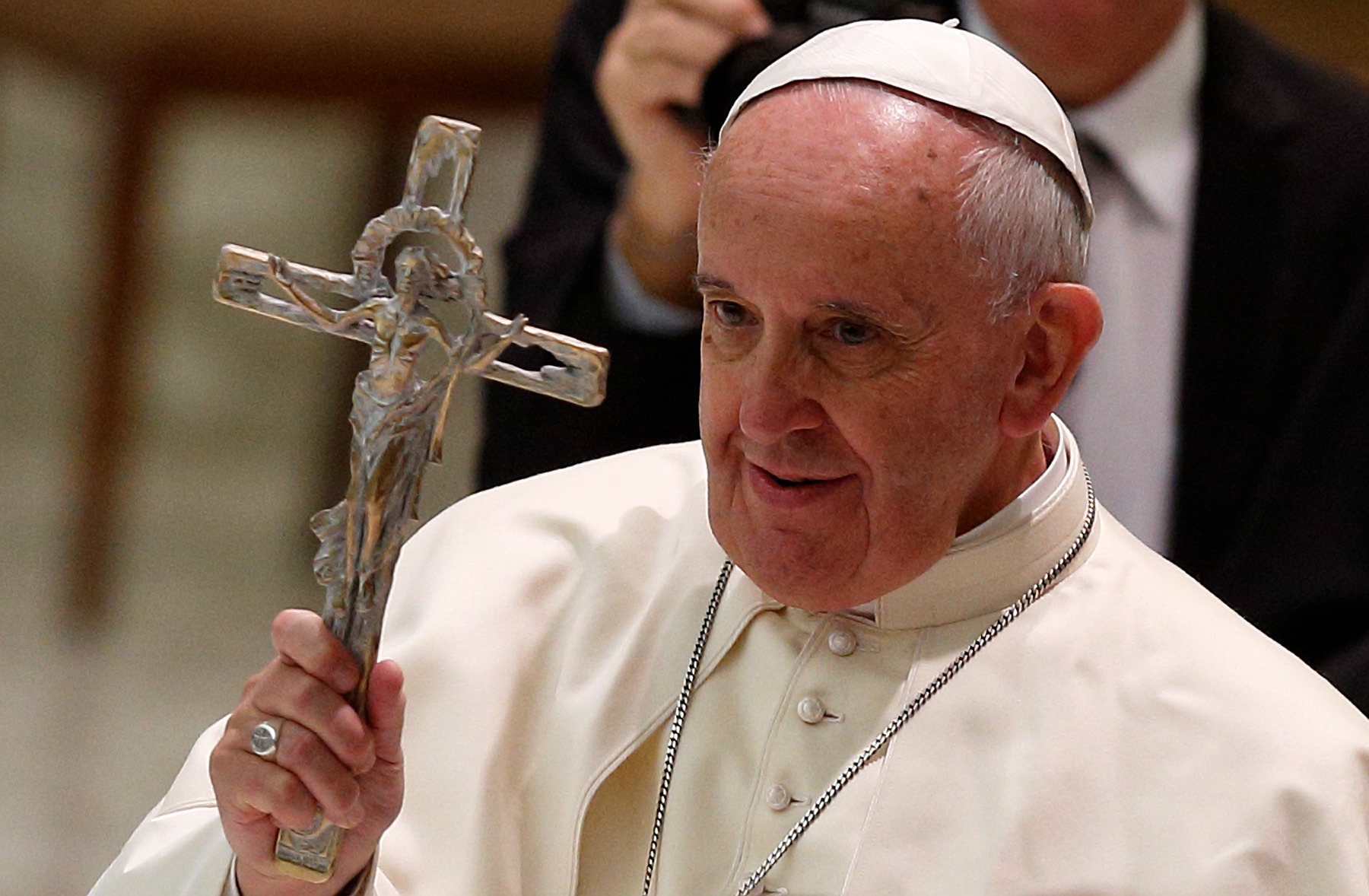

From hidden tax breaks to opaque finances and political influence, Italy’s most untouchable institution drains public resources while shielding itself behind faith
I write this as much of the world mourns the death of Pope Francis.
A few days ago, I drove to Rome — not as one of the hundreds of thousands of pilgrims lining up for the funeral, but simply for a family celebration.
Yet as an Italian citizen, I couldn’t shake off a deep sense of disgust.
While banners praised humility and sacrifice, while official speeches glorified a man of God, nobody — absolutely nobody — dared to mention the real elephant in the room.
Or rather, the cardinal.
Each year, the Vatican and the Catholic Church drain billions of euros from Italian taxpayers through a hidden network of privileges, subsidies, and legal loopholes.
It’s not divine intervention keeping the Church alive.
It’s our money.
And most people don’t even realize it.
An institution that preaches poverty, yet thrives on wealth.
That demands sacrifice, while living off tax breaks and cozy silences.
And no — asking for transparency isn’t blasphemy.
It’s common sense.

How much does the Church really cost Italian taxpayers?
Economist sources (like Economia Italia) estimate the total cost of supporting the Catholic Church in Italy between €2 and €10 billion annually, depending on how broadly you calculate the benefits, exemptions, and subsidies.
Here’s a quick breakdown:
- 8×1000 tax allocation: About €1 billion every year. Even though only 28% of taxpayers actively choose the Catholic Church, it receives about 70% of the total 8×1000 funds, because unexpressed choices are automatically redirected to it.
- Property tax exemptions: For decades, Church-owned buildings — even those used for commercial purposes — were exempt from ICI (the old property tax) and later IMU (the current municipal tax). Studies from laVoce.info and local government reports estimated annual losses of around €300 million just for Rome.
The European Court of Justice even ruled in 2018 that these exemptions were illegal state aid — yet little has been recovered. - Subsidies to Catholic schools: About €700 million per year supports “private” Catholic schools, even though they mostly serve wealthier families. These schools benefit from tax breaks and direct public funding under laws that date back to 2000.
- Religion teachers in public schools: The Italian state employs around 25,000 religion teachers, costing an estimated €700–900 million annually. These teachers are selected by the Church but paid by the taxpayers.
- Clergy pensions: Priests and religious workers benefit from a separate pension system (the “Fondo Clero”) that’s heavily subsidized and not based on actual contributions, causing further public deficits.
And yet, no official government report provides a clear, complete accounting of these costs. Transparency is missing by design — not by accident.

“Charity” as a shield for privilege
Defenders argue that the Church’s social work offsets these costs.
But there are no serious studies comparing Catholic charities’ effectiveness with secular NGOs that operate without billions in public subsidies.
Where does the 8×1000 really go?
The Church claims it uses the 8×1000 to help the poor — and in part, that’s true.
But some of those funds also help cover legal fees and settlements related to abuse scandals, a reality the Vatican rarely publicizes.
As reported by Domani and many others, defending itself in court has become an economic burden for the Church — and a reputational disaster.
And it’s not just an Italian issue: this legal hemorrhage is global, and costs billions.
“Do you know how much lawyers cost?”
Apparently, more than charity.
It’s about bigotry and control
As Economia Italia pointed out, these financial privileges help entrench the Church’s influence in Italy’s social, cultural, and political life — well beyond religious practice.
This influence has concrete, damaging effects.
As an Italian entrepreneur, I’ve seen firsthand how religious conservatism — weaponized through political lobbying — has slowed down modernization, restricted civil rights, and even strangled emerging industries.
For example, absurd restrictions on hemp and CBD businesses — mine included — were fueled by a moral panic orchestrated by the same political forces that protect the Church’s privileges.
It’s not just about money.
It’s about power, censorship, and lost opportunities for an entire country.
The hidden empire: the Church as a secretive financial power
The Catholic Church today is not just a religious institution.
It operates as one of the world’s oldest and most opaque financial empires — using faith as a marketing system to maintain control over populations and wealth.
This is not conspiracy theory.
It’s documented history.
The Vatican’s own bank, officially called the Institute for the Works of Religion (IOR), has been repeatedly implicated in scandals involving money laundering, secret accounts, and even the financing of arms deals.
Sources like “God’s Bankers” by Gerald Posner and the 1980s investigations into the Banco Ambrosiano collapse reveal how deep these operations run.
In the Ambrosiano case, the Vatican was linked to illicit funds channeled through secret accounts, mafia operations, and illegal financing of political and military operations abroad.
The IOR has operated for decades with almost no external oversight — protected by Vatican sovereignty, shielded from normal financial regulations, and immune to prosecution under Italian or European law.
Even internal efforts to “reform” the Vatican Bank have been largely cosmetic.
As documented by Financial Times and Reuters, while some transparency measures were announced after 2013, the core structure remains closed, self-governed, and accountable to no external authority.
In essence, the Church has built a financial empire hidden behind a religious front — leveraging centuries of trust to conduct activities that would raise alarms if done by any secular institution.
Faith is the brand.
Money and power are the business.
Myths vs facts about the Church’s finances
Myth 1: “The Church survives only on voluntary donations.”
Fact:
Thanks to tax systems like the 8×1000, billions are transferred automatically — even when taxpayers don’t actively choose it.
Myth 2: “All Church money goes to charity.”
Fact:
Independent audits are rare. No comprehensive public accounting shows how much actually supports charitable work. Recent estimates talk about less than 30% of funds being allocated to charity.
Myth 3: “The Church lost its privileges after the Lateran Pacts ended.”
Fact:
Many financial and legal advantages were reaffirmed in the 1984 revisions (by the famously corrupt Craxi government) — and still exist today.
Why real transparency matters
Italy’s Constitution declares it a secular state.
But in reality, religious institutions — especially the Catholic Church — maintain a vast, opaque, and deeply entrenched power over public policy, education, property markets, and public finances.
Demanding accountability is not an attack on faith.
It’s basic democratic hygiene.
If you pay taxes in Italy, you have every right to ask:
Where exactly is my money going?
And why is someone else’s faith still funded at my expense?
A brief history: how the Church secured its privileges
To understand why the Catholic Church still holds so much untouchable power in Italy, you have to look back at history — especially the Lateran Pacts of 1929.
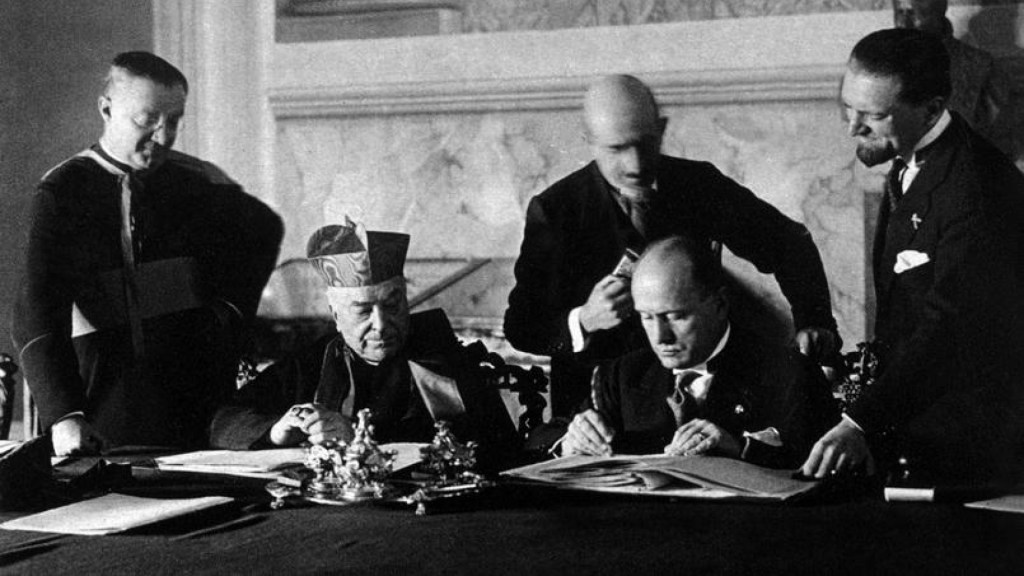
In the midst of Fascism’s rise, Benito Mussolini struck a deal with the Vatican.
The Lateran Pacts recognized the Vatican City as an independent state, granted massive financial compensations to the Church, and gave Catholicism a privileged role in Italy’s legal and social system.
In return, the Church gave its blessing to Mussolini’s regime — providing crucial support to his dictatorship.
This wasn’t an isolated case.
Similar alliances happened in Nazi Germany, where the Catholic Church initially signed a Concordat with Hitler in 1933, seeking to protect its interests even at the cost of turning a blind eye to the early crimes of the regime.
The Lateran Pacts embedded Catholic privilege deep into Italian law — and even today, their legacy shapes national politics.
The agreements were reaffirmed (albeit revised) in 1984, but many financial, legal, and educational privileges remained intact.
The result?
A Church that still enjoys state-like protections inside a supposedly secular republic.
Without understanding this historical context, it’s impossible to grasp why questioning Church funding remains such a taboo — or why reforms are so painfully slow.
How citizens can fight back
Change won’t come from politicians — especially those who owe their careers to Church-backed parties.
It has to start from the bottom.
Here’s what ordinary citizens can do:
- Refuse to allocate your 8×1000 to the Catholic Church — and inform others how the system silently redirects unexpressed choices.
- Support campaigns for full transparency on all public funds and tax breaks granted to religious institutions.
- Demand secular education in public schools, without hidden religious influence.
- Vote for candidates who openly advocate for a clear separation between Church and State — not just in words, but in policies.
- Speak up: break the taboo. Talk about this openly with family, friends, colleagues. Silence protects the status quo.
Without public pressure, nothing will change.
Pope Francis is gone — but the Vatican’s financial machine lives on
A man has died.
But Italy’s greatest parasite lives on — thriving, feeding, protected by silence.
It’s not enough to mourn.
It’s time to open our eyes, follow the money, and break the spell.
Because blind faith is expensive.
And the bill, as always, comes for all of us.
FAQ: Common questions about Church funding in Italy
Q: Is Italy really a secular state?
A: Constitutionally, yes. In practice, the Church retains massive influence through financial and political privileges.
Q: How much does the Catholic Church cost Italian taxpayers each year?
A: Estimates range from €2 to €10 billion annually, depending on the inclusion of indirect subsidies.
Q: Can citizens choose not to fund the Church?
A: Partially. Declaring your 8×1000 destination helps, but unassigned funds still disproportionately favor the Church.
Further resources:
- For a detailed analysis, watch: Quanto COSTA al CONTRIBUENTE la CHIESA CATTOLICA? Guardiamo i DATI (Italian, translatable with automatic subtitles. It shows clear and balanced data, check it out).
- laVoce.info – Various articles on ICI/IMU property tax exemptions (Economic analysis of how Church property tax privileges impact Italian public finances.)
- European Court of Justice ruling, 2018 (Official decision declaring that Italy’s tax exemptions for religious institutions constituted illegal state aid.)
- Pagella Politica – Fact-checking on Church-related public costs (Critical review of estimates regarding unpaid taxes and financial advantages granted to the Church.)
- Reichskonkordat (1933) (Concordat signed between the Vatican and Nazi Germany, aimed at securing the Church’s interests in exchange for political legitimacy.)
- David I. Kertzer – The Pope and Mussolini (Pulitzer Prize winner) (Historical investigation documenting the alliances between the Vatican and Fascist Italy.)
- Gerald Posner – God’s Bankers (Amazon) – Investigation into Vatican finances.
- Rupert Cornwell – God’s Banker (Amazon) – Reporting on the Banco Ambrosiano scandal.
- Financial Times – Vatican Bank reforms coverage – Analysis of Vatican financial reforms.
- Reuters – Vatican Bank news archive – Ongoing reports on Vatican Bank transparency and scandals.

