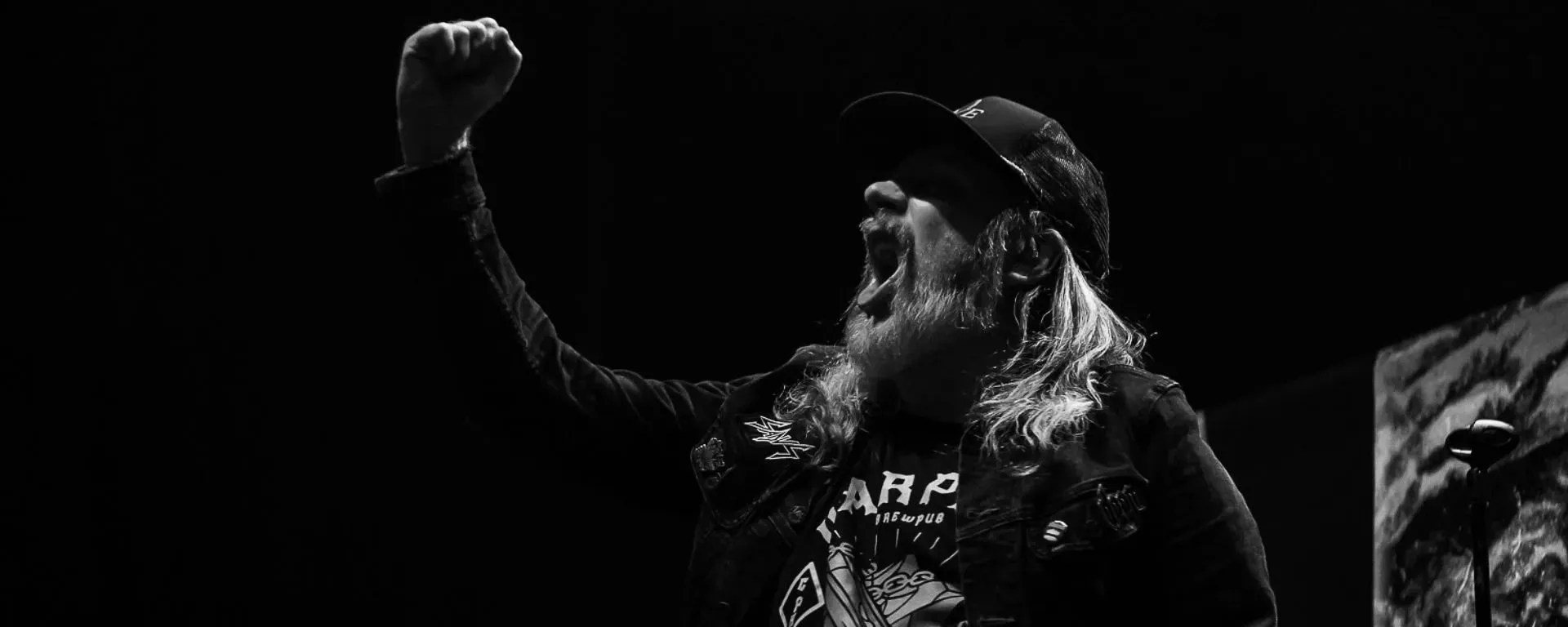

I still can’t believe almost nobody talks about this band — one of Tomas “Tompa” Lindberg’s most daring and overlooked creations.
When we speak of Tompa, we think of At the Gates and the invention of melodic death metal. We think of Slaughter of the Soul and its influence on an entire generation of metal musicians. We think of Disfear and the crust-punk ferocity that defined another side of him. But rarely, almost never, do we hear anyone mention The Great Deceiver.

That silence feels wrong.
Because The Great Deceiver wasn’t just another side project. It was an experiment in language, in texture, in philosophy — a place where Tompa seemed to ask: what happens when the scream itself starts to think?
My connection to Tompa
I discovered Tompa’s voice around 2002 or 2003 — through one of those thick, glossy magazines we used to buy at the newsstand, full of reviews, interviews, and grainy photos.
I must have been twenty, maybe less, and at that time I was fronting a small band called Gardens of Grief, named in honor of At the Gates’ first ep.
We played an early form of metalcore infused with death metal influences, and though I had no formal vocal training, I tried to channel that same energy — raw, desperate, intelligent. I even brought a knife to scare people who stood still into joining the moshpit :)
Back then, I didn’t know he would become such a constant presence in my creative life.
When I heard of his passing — throat cancer, eeriely similar to the illness that took LG Petrov of Entombed not long before — it hit me hard. These were men whose voices had literally shaped how I understood art, rebellion, and human fragility. Their deaths reminded me that metal, for all its aggression, is ultimately about mortality. About confronting what most people try to look away from.
After that, I went back and listened again. Not to At the Gates, but to the albums people rarely mention. And that’s when The Great Deceiver resurfaced for me like a ghost.
The trilogy that few remember
The Great Deceiver released three full-length albums:
- A Venom Well Designed (2002, Peaceville Records)
- Terra Incognito (2003, Peaceville Records)
- Life Is Wasted on the Living (2007, Deathwish Inc.)
Each has its own character, but Terra Incognito is the one that refuses to age. It’s the most unsettling, the most poetic — the one where Tompa went beyond genre. It’s the sound of a man refusing to be trapped by his own legacy.
You can feel it in the opener, Pierced, and especially in Faust in Exile, where his voice alternates between rage and lament. The production is dry, industrial, almost claustrophobic. Guitars scrape like machinery, and yet there’s a strange beauty underneath — something cold but very human.
It doesn’t sound like At the Gates. It doesn’t even try to. It sounds like someone thinking through distortion.
It had such a huge impact on me that I featured it on this same blog back in 2010 (in Italian, along with their videos)
Between scream and sermon
Most fans associate Tompa with his iconic scream — that high, anguished rasp that influenced countless vocalists. But with The Great Deceiver he experimented with something far riskier: diction and clarity.
He allowed moments of clean vocal phrasing, half-spoken lines, and poetic recitations. They don’t came often, but when they did, they sliced through the noise. It was as if he was pulling the listener closer, whispering in the middle of chaos.
That choice — to expose his voice, to make it fragile — is what makes these albums so fascinating. Extreme metal often hides behind volume, distortion, and speed. Tompa, for once, seemed to remove the armor.
From nihilism to revolt
Many metal bands sing about darkness, but few interrogate it. Tompa did.
In The Great Deceiver, you don’t find the clichés of satanic rebellion or gore. His lyrics were about something far deeper: existential revolt. His words read like a dialogue with philosophers — Camus, Orwell, Nietzsche. Not as name-drops, but as living presences. He turns their ideas into sound.
From Camus, he borrows the idea of resistance without hope — the courage to live without meaning and yet affirm life. From Orwell, the awareness of manipulation, of media and ideology shaping our perception of truth. From Nietzsche, the creative destruction that art demands: to build, you must first destroy the false idols.
In this sense, The Great Deceiver isn’t just music; it’s a philosophical statement disguised as extreme metal.
Out of place, out of time
When Terra Incognito came out, the musical landscape was dominated by nu-metal and metalcore — genres driven by production trends and radio expectations. The Great Deceiver didn’t fit anywhere. It was too intellectual for hardcore fans, too abrasive for mainstream listeners, too avant-garde for death metal purists.
Peaceville released it, but it never received the kind of push it deserved. And yet, twenty years later, it sounds modern. Its mix of mechanical grooves and post-punk melancholy feels closer to what many experimental metal bands are doing now — from Cult of Luna to Oathbreaker.
Sometimes art arrives before the world is ready for it.
The teacher behind the scream
Tompa was, above all, a teacher. That was his real-life job — teaching high-school students in Sweden. I find that detail moving: the man who screamed about existential despair spent his days educating the next generation.
It’s almost mythic, that contrast. But maybe that’s the key to his artistry. The classroom and the stage were two sides of the same calling: to awaken minds.
I’ve always admired artists who live that paradox — who can rage against meaninglessness on stage, then go home and make breakfast for their children or grade a student’s paper. It proves that rebellion doesn’t need to be destruction. It can also be care.
The overlooked courage
When I listen to Terra Incognito today, I don’t just hear riffs and screams. I hear someone refusing to conform — musically, intellectually, spiritually.
That’s a rare kind of courage. Most of us, even in art, try to repeat what worked. Tompa did the opposite: he risked obscurity to stay authentic.
And in doing so, he created something timeless.
His death at 52 is heartbreaking, but his life remains a lesson. Like Russell Blake once wrote to aspiring creators: you have a limited life expectancy — so if you’re going to write, sing, or scream, do it for real.
That’s what Tompa did. He lived and created as if every album could be his last.
Why it matters now
We live in an age where attention is fractured, where music is consumed in seconds and forgotten in minutes. In that context, rediscovering entire albums, produced as such over 20 years ago, feels almost revolutionary.
Listening to it demands patience, reflection, and surrender.
And maybe that’s what I miss most in modern metal: that willingness to engage the intellect without losing the visceral. Tompa embodied that synthesis — rage fused with reason, chaos shaped by clarity.
He proved that the loudest art can also be the most thoughtful.
What remains
When I think of him now, I picture a classroom in Gothenburg, a teacher quietly closing his notebook after a lesson. I imagine the same man, years earlier, standing in front of a microphone, screaming lines that sound like prophecy.
Between those two scenes lies the essence of who he was: an artist who gave everything, both mind and voice, to express what it means to exist in contradiction.
The Great Deceiver wasn’t just a band. It was a mirror.
It showed us that even in the harshest sounds, there’s room for truth, vulnerability, and thought.
That’s why I believe Terra Incognito is not just Tompa’s most underrated album — it’s his most human one.
P.S.
Shoutout to The Devil’s Mouth for its Deep Dive. It’s the only place where I’ve found a detailed overview of Tomas’ legacy.

